What Is Agriculture Farming?
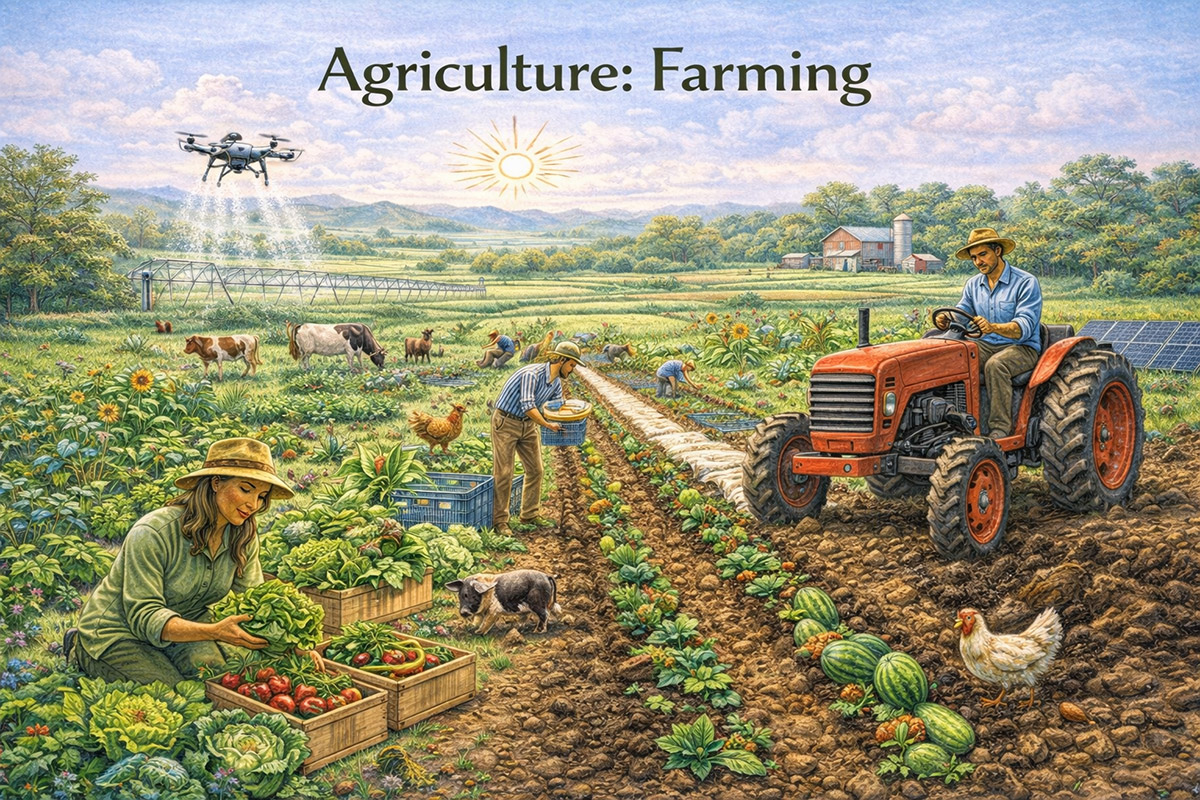
Agriculture farming is the cultivation of land, plants, animals, and aquatic systems to produce food, fiber, and other essential resources. In regenerative and circular models, agriculture is not just production, it is the management of living ecosystems, where soil, water, plants, animals, and microorganisms function together in continuous nutrient and energy cycles. Historical agricultural systems in the ancient Tamil region demonstrate early forms of regenerative circular farming, characterized by nutrient recycling, mixed cropping, livestock integration, and sophisticated water management practices that sustained soil health over centuries. Modern agriculture includes integrated systems such as:- Crop and horticultural production (vegetables, fruits, melons, flowers)
- Livestock and poultry systems that contribute nutrients back to the land
- Aquaculture integrated with land-based farming
- Greenhouse and nursery production
- Organic, regenerative, and agroecological farming
- At the center of all these systems is soil health, driven by both biotic (living) and abiotic (non-living) diversity.
Importance of Agriculture
- Food and Nutritional Security: Agriculture sustains human populations by providing diverse, nutrient-rich food through resilient production systems.
- Economic and Community Resilience: A
- Farming supports livelihoods, local economies, and rural communities while strengthening regional food systems.
- Environmental Stewardship: When practiced regeneratively, agriculture enhances soil fertility, increases biodiversity, improves water retention, and reduces external inputs by recycling nutrients within the system.
- Cultural Heritage: Agricultural knowledge connects generations, preserves ecosystems, and maintains relationships between land, people, and food.
Lorem ipsum dolor sit amet, consectetur adipiscing elit. Ut elit tellus, luctus nec ullamcorper mattis, pulvinar dapibus leo.
Soil: The Foundation of Agriculture
Healthy agriculture depends on soil diversity, which includes:
- Biotic (Living) Components
- Microorganisms (bacteria and fungi) that cycle nutrients and support plant growth
- Microfauna and mesofauna (nematodes, mites, springtails) that regulate microbial populations
- Macrofauna (earthworms, insects) that improve soil structure and aeration
- Plant-associated biota in the rhizosphere that enhance nutrient uptake
Abiotic (Non-Living) Components
- Physical structure (texture, aggregation, porosity)
- Chemical balance (organic matter, pH, macro- and micronutrients)
- Mineral content
- Water and gas exchange within the soil profile
Together, these elements create fertile, resilient soils that drive productive farming systems.
- Climate change and extreme weather events
- Soil degradation, erosion, and loss of organic matter
- Water scarcity and inefficient resource use
- Pest and disease pressure from simplified systems
- Market volatility and limited access to tools and capital for small farmers
- These challenges highlight the need for regenerative, circular approaches.
- Crop rotation and diversification to support soil biology
- Integrated livestock and poultry systems for nutrient cycling
- Mulching, composting, and organic amendments to build soil carbon
- Water reuse and conservation strategies
- Agroecology and regenerative farming that mimic natural ecosystems These practices close nutrient loops, reduce waste, and strengthen long-term productivity.
The future of agriculture lies in regenerative circular systems that prioritize soil health, biodiversity, and resource efficiency. By integrating technology with ecological knowledge, such as soil biology, climate-resilient crops, and closed-loop nutrient management, agriculture can meet global food needs while restoring ecosystems and protecting the planet.